Description
Antim Tart 3X
Introduction: Due to the emetic influence of the drug it is known as “Tartar Emetic”. Emetic is
a substance which when taken in can make a person vomit. This vomiting is caused due to
irritation of the base of brain in medulla oblongata. Tartar emetic is a compound-salt of antimony
and potash; both substances depress the circulation. So it causes more weakness of the heart and
lungs than does antimony itself. Many years ago an ointment of Tartar emetic was applied as a
counter irritant but it causes too much pain and is now seldom used. In Homoeopathy the
principal indications for Antim. tart. are : Coarse rattling of mucous in the chest. Horrible nausea
coming in waves, better from vomiting. Aversion to being touched or looked at.
Synonyms : Tartar emetic, Tartarate of Antimony and potash.
Source: It is a chemical salt of Antimony and Potassium, formula: 2(K[Sbo]C4H4O6)H2O.
Preparation: The salt is triturated with sugar of milk.
Proved by: Dr. Hahnemann and Dr. Hencke.
Guiding symptoms/Indications:
1. Confused intelligence; disturbed judgment; indecisive; things he knows seem to him to be
unreal (Med.).
2. Confusion of his identify (when he says or sees anything, he feels as if another person said it,
or saw it), as if he could transfer himself into another and only then could see.
3. Mistakes in writing and speaking; uses words not intended.
4. Sluggish and slow; sensations are slow in being transmitted to the centre (stool, urine, prick of
a needle).
5. Time passes too slowly, an hour seems half a day (Cann. ind).
6. Paretic weakness (passing stool, tottering gait, etc.)
7. Extreme dryness of skin or mucous membranes.
8. Sensation of splinter in throat, fissures, cracks (Nit. ac).
9. Must strain at stool to urinate.
10. Gait tottering, after severe illness; unable to walk except with eyes open – staggers when
walking with closed eyes and in darkness.
11. Leucorrhoea acrid, profuse, running down to the heels (Syph.).
12. Inactivity of rectum; no desire until accumulation of a large stool; stools dry like sheep
dung.Passes stool easily when standing.
13. Craving for indigestible things. Potatoes disagree.
Particulars:
Head: Hair falls out all over body.
Eyes: Eye- lashes fall out. Blepharitis, with great dryness of conjunctiva. Chronic blepharitis.
Eyes dry on reading. Direction of pains : Pains go upward.Or upper left and lower right side
are affected (Rev. Lyc.).
Ptosis – paralytic drooping of eyelids (Caust.)
Face: Sensation of dried white of egg on face, or of a cobweb on face.
Rectum: Paretic weakness : of rectum. Even a soft stool needs great straining. Must strain at
stool to urinate.
Female : Leucorrhoea alternating with catarrh of nose and throat.
Gonorrhoea chronic : when no other medicine has acted deeply.
Larynx- Voice: Paralytic weakness of vocal cords ending in hoarseness or loss of voice.
Cough: Cough violent, caused by elongated uvula (Dunham).
Extremities: Feels as if walking on cushions. Gait ataxic; unable to walk with eyes closed. Great
weakness and heaviness in legs, chiefly in hips. Trembling of knees. Slow tottering gait as after
severe illness. Unable to walk except with eyes open, and in the daytime.
Skin: Absence of sweat with dryness and harshness of skin. All skin symptoms are worse in
winter. Dryness of skin – perspiration rare and scanty. Nails have a tendency to break when they
are cut. Dryness of skin and mucous membranes or profuse secretion from the latter. Dryness of
skin with tendency to itch (with or without eruptions); skin cracks, thickens, bleeds, or ulcerates
and indurates. Intolerable itching of the whole body, esp. from warmth of bed. Has to scratch
until the skin bleeds.
General: Chronicity, when complaints improve for a time and relapse for no reason. For old
people with lack of vital heat, or for premature old age with debility.
Sleep: Dreams anxious; confused; of falling; of fire; robbers; snakes; stars falling; water;
wedding.
Physiological action:
1. Acts directly upon the nerve centres at the base of the brain and medulla oblongata.
2. Tartar emetic exerts its power on the mucous membrane of the stomach, lungs and liver; at the
same time through the pneumogastric nerve, depressing in a remarkable degree the circulating
and respiratory system. This stimulation of the vagus is both centrifugal and centripetal.
3. Nausea and vomiting are the only manifestations of its action on the medulla.
4. On the mucous membranes, there will be catarrhal inflammation.
5. The drug promotes a rapid waste of tissues.
6. On the skin we have pustular eruptions resembling small-pox.
Constitution: 1. Appearance : Ant. tart has got hydrogenoid constitution of Grauvogl, torpid,
phlegmatic person; child at birth is pale.
(Hydrogenoid constitution of Grauvogl is characterised by excess of hydrogen in the system).
2. Miasm : Psora and sycosis are in the back ground.
3. Diathesis : Scrofulous diathesis.
Dose and administration: 1 tab 3 to 4 times daily for adult. ½ tab for 3 to 4 times daily
children.
Side effects: No significant side effect has been observed in proper dosage
Contraindication: There is no known contraindication.
Relationship: Antidotes: Puls; Sepia.
Compare: Kali sulph; Ipecac.
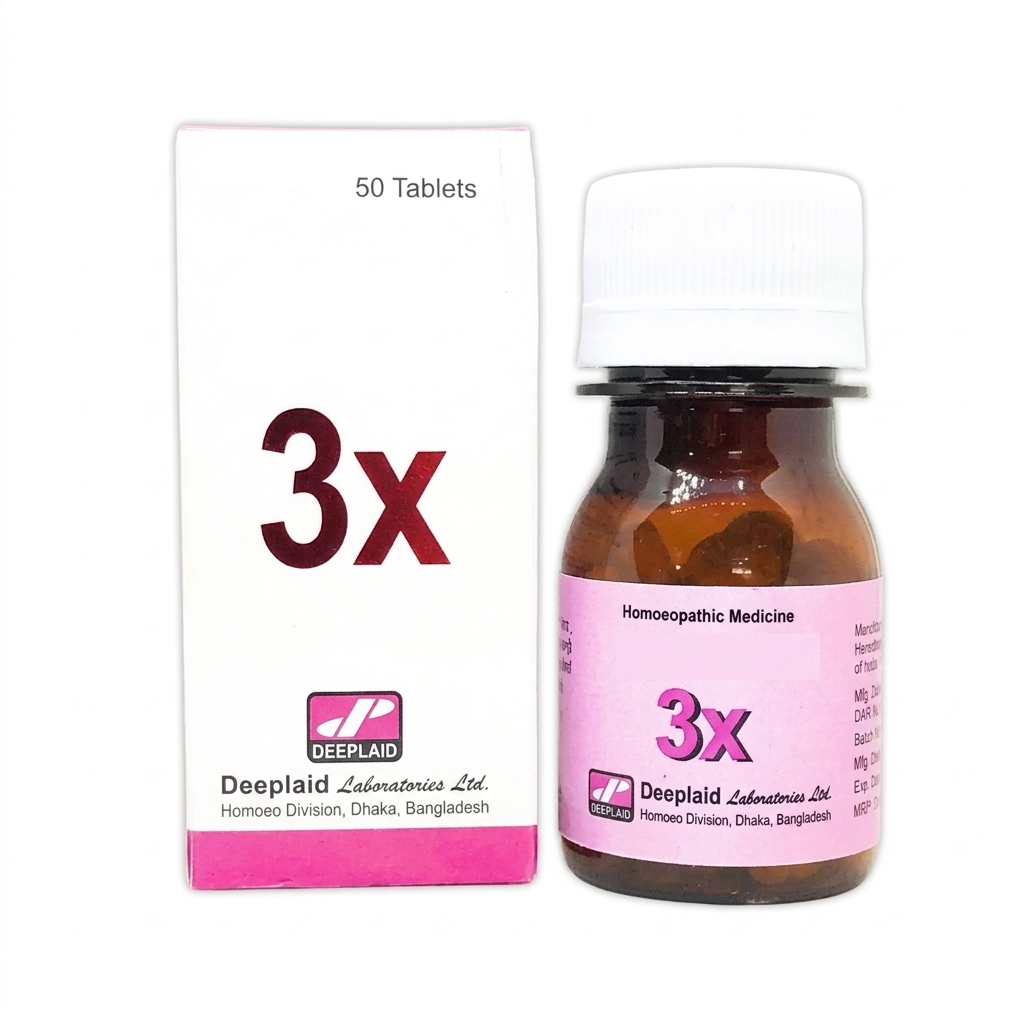
Presentations: 50 tabs (20 gm in PET bottle), 450gm powder in container.



Reviews
There are no reviews yet.