


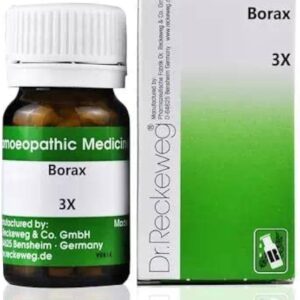
Borax 3X
Introduction: This crystalline salt is useful for soldering and as flux in technical works. This salt
in its crude form for several centuries, was brought by venetians from the West Indies, especially
from lakes in Tibet; therefore it is still called borax veneta. Afterwards it was refined by the
Dutch, by a process and kept secret and was then brought into commerce. In later times it was
manufactured by the French, by an addition of soda to a kind of boracic acid brought from some
hot springs and lakes of Tuscany in the neighbourhood of Sasso. Borax consists 22 parts boracic
acid, 32 parts soda and 46 parts of water; it is consequently not fully neutralized by its acid,
which appears in shiny scales, of a taste slightly acidic in nature.
Synonyms: Biborate of Soda.
Source: It is a chemical compound of Sodium having the formula Na2B4O7. 10H2O. It is
available in the market at any chemist shop.
Preparation: Triturations are prepared with sugar of milk.
Proved by: Dr Hahnemann.
Guiding symptoms/Indications:
1. Dread of downward motion in nearly all complaints.
2. There is great anxiety from downward motion.
3. When the child lies in a crib, cries and clings to the nurse when Anxious rocking, dancing,
swinging, going downstairs.
4. Children awake suddenly, screaming and grasping sides of the cradle without apparent cause
(Apis. mel., Cina., Stram.).
5. Excessively nervous, easily frightened by the slightest noise or an unusual sharp sound, a
cough, sneeze, a cry, lighting a match etc. (Asar., Calad.).
6. Nostrils crusty, inflammed.
7. Tip of the nose is red, shining (Bell., Phos., Sulph.).
8. Stoppage of right nostril or first right then left with constant blowing of nose (Am. c., Lac. c.,
Mag. m.).
9. Hair becomes frowsy and tangled, splits, sticks together at the tips; if these branches are cut
off they form again, cannot be combed smoothly (Fl. ac., Lyco., Psor., Tub.).
10. Eyelashes are loaded with dry, gummy exudation, agglutinated in morning (Arg. nit., Apis.
mel., Euph., Merc. s., Rhus. tox.; at night, Thuja. o.).
11. Aphthae in mouth, on the tongue, inside of the cheek, There is tendency to bleed while
eating; on slightest touch. There is hot feeling in mouth with dryness and thirst. (Ars. alb.).
Bleedig cracls on tongue (Arum.) with salivation, especially during dentition.
12. Child is having frequent urination and screams before urination (Lys., Sanic., Sars.).
13. Leucorrhoea is profuse, albuminous, starchy with warm sensation as if warm water is
flowing down, especially between the catamenia.
14. Skin, unhealthy, slight injuries suppurate (Calend., Hep. s., Merc. s., Sil.).
Particulars:
1. In aphthae :
Aphthae found in the mouth, on tongue and inside the cheeks.
Buccal mocous membrance looks red and there is a tendency to bleed easily, during eating or
when touched.
Mouth is felt hot by the patient with increased salivation.
Soreness is aggravated by taking salt and sour things.
Aphthae from mouth stomach which cause constant vomiting of sour lime.
2. Borax lady :
Menstrual flow is found to be membranous with dysmenorrhoea. Hence it is indicated in
membranous dysmenorrhoea. Patient feels a violent labour like pain before and during menses,
as if uterus will expel itself through vagina. Menstrual blood is very much hot. The flow
continues slightly but violent pains keep on until the membrane is expelled. In some cases such
membrane may be the casts of uterus. Such patients are easily startled from downward motion,
motion like sewing, rocking. During menses there is throbbing headache and buzzing sound in
ear. Mentally she is nervous and excitable. Borax lady may suffer from leucorrhoea which is
profuse, characteristically albuminous, starchy and very much acrid which excoriates the thigs.
She feels as if warm water is flowing. Exactly it looks like white of an egg. It lasts for two
weeks, pregnancy is prevented from it.
3. Borax baby:
The appearance of Borax baby is pale, with earthly face, rednose, laxed skin and muscles.
The child may have small vesicles around the mouth and on forehead. Children are oversensitive
and have dread of downward motion. While lying on a couch or in cradle or a crib, the baby cries
and clings to the nurse (Cham.). Children have frequent desire for micturition and screams before
passing urine. Children cannot suck the breast due to sore mouth. Children often get summer
complaints. There are ulcers around the anus. Stool is frequent, soft, light, yellow and slimy in
nature.
Dose and administration: 1 tab 3 to 4 times daily for adult. ½ tab for 3 to 4 times daily
children.
Side effects: No significant side effect has been observed in proper dosage
Contraindication: There is no known contraindication.
Relationships:
Comparisons
1. aphthae :
(a) Borax : Inflammation of mouth appears as a concomitant of diarrhoea.
Mouth is hot.
(b) Bry. alb. : Child refuses to nurse or makes great fuss about it but as soon as his mouth is
moistened he takes hold of the nipple and nurses energetically.
(c) Merc. sol. : With sore mouth, has profuse salivation agg. at night, with thirst.
(d) Arum. t. : It is differentiated from Borax by its violence of symptoms and is accompained by
soreness, scabs around the mouth and nostrils.
2. Sensitiveness:
Borax patient is very sensitive to all sorts of noises that is even to a cough, a sneeze, crackling of
paper, a cry, distant shot, etc.
At the same time Belladonna is sometimes given for this type of noise.
Fer. met. has got irritability, that is to slightest noise like crackling of paper which drives him to
despair.
But the differentiation between Belladonna and Fer. met. is that Bell., has got redness of the face
whereas Fer. met. has got paleness.
Antidoted by : Cham., Coffea.
Incompatible : Acet. ac., Vinegar, Wine.
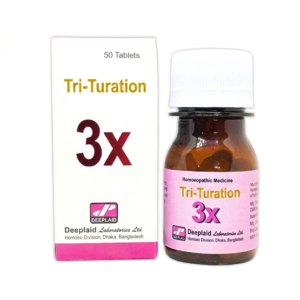
Presentations: 50 tabs (20 gm in PET bottle), 450gm powder in container.
| Gram | 25GM, 450GM |
|---|

Reviews
There are no reviews yet.